
SaaS vs On-Premise Software: Which is Better for Business?
A complete comparison to help you choose the right software model for your business
Choosing the right software is one of the most important decisions you will make for your business. It affects your productivity, operational efficiency, cost structure, and long-term scalability. Whether you are running a startup or managing a large enterprise, your software infrastructure plays a critical role in how your business performs every day.
Today, businesses face a key decision: should you choose modern cloud-based SaaS solutions, or stick with traditional On-Premise software? Both options have advantages and limitations, and the right choice depends on your business goals, budget, and operational needs.
In this guide, we break everything down in a clear, practical way so you can confidently decide which model is best for your business.
What is On-Premise Software?
On-Premise software is the traditional model where applications are installed directly on your company’s computers and servers. Your business owns the infrastructure, including hardware, storage, and networking systems.
Your IT team is responsible for managing updates, maintenance, security, and backups. While this provides full control, it also requires significant resources and technical expertise.
- Installed locally on company servers
- High upfront investment
- Full control over data and systems
- Maintenance handled internally
What is SaaS (Software as a Service)?
SaaS is a cloud-based software model where applications are hosted online and accessed via the internet. Instead of installing software locally, you subscribe and use it through a browser or app.
The provider manages infrastructure, updates, and security, allowing businesses to focus on operations rather than IT maintenance.
- Accessible from anywhere
- Subscription-based pricing
- Automatic updates
- Highly scalable
SaaS vs On-Premise: Key Differences
💰 Cost
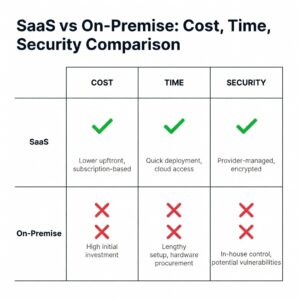
SaaS offers low upfront cost with predictable monthly pricing. On-Premise requires significant investment in hardware and licenses.
🛠️ Maintenance
SaaS providers handle updates automatically. On-Premise requires internal IT teams to manage everything.
🔒 Security
On-Premise offers control, while SaaS providers offer advanced enterprise-grade security systems.
📶 Accessibility
SaaS allows remote access from any device, while On-Premise is limited to internal networks.
📈 Scalability
SaaS scales instantly, while On-Premise requires hardware upgrades.
Quick Comparison
| Feature | SaaS | On-Premise |
|---|---|---|
| Cost | Low upfront | High upfront |
| Access | Anywhere | Office only |
| Maintenance | Provider | Internal IT |
| Updates | Automatic | Manual |
| Scalability | High | Limited |
Which One Should You Choose?
Choose SaaS if:
- You want low upfront cost
- You support remote teams
- You lack IT infrastructure
Choose On-Premise if:
- You need full data control
- You have strong IT resources
- You operate under strict regulations
Final Thoughts
SaaS is leading the future due to its flexibility and efficiency, but On-Premise still plays a role for specific industries. Many companies now use hybrid models combining both.
Stay Ahead in Technology
Explore more guides, comparisons, and tech insights to make smarter decisions.